Manufacturers have invested heavily in automation, and most will tell you it’s working. Uptime is good, dashboards are green. But ask them what happens when a supplier calls with a three-day delay or when a quality deviation surfaces mid-run. The answer is almost always the same: someone figures it out. Manually. Across a handful of systems and a few phone calls.

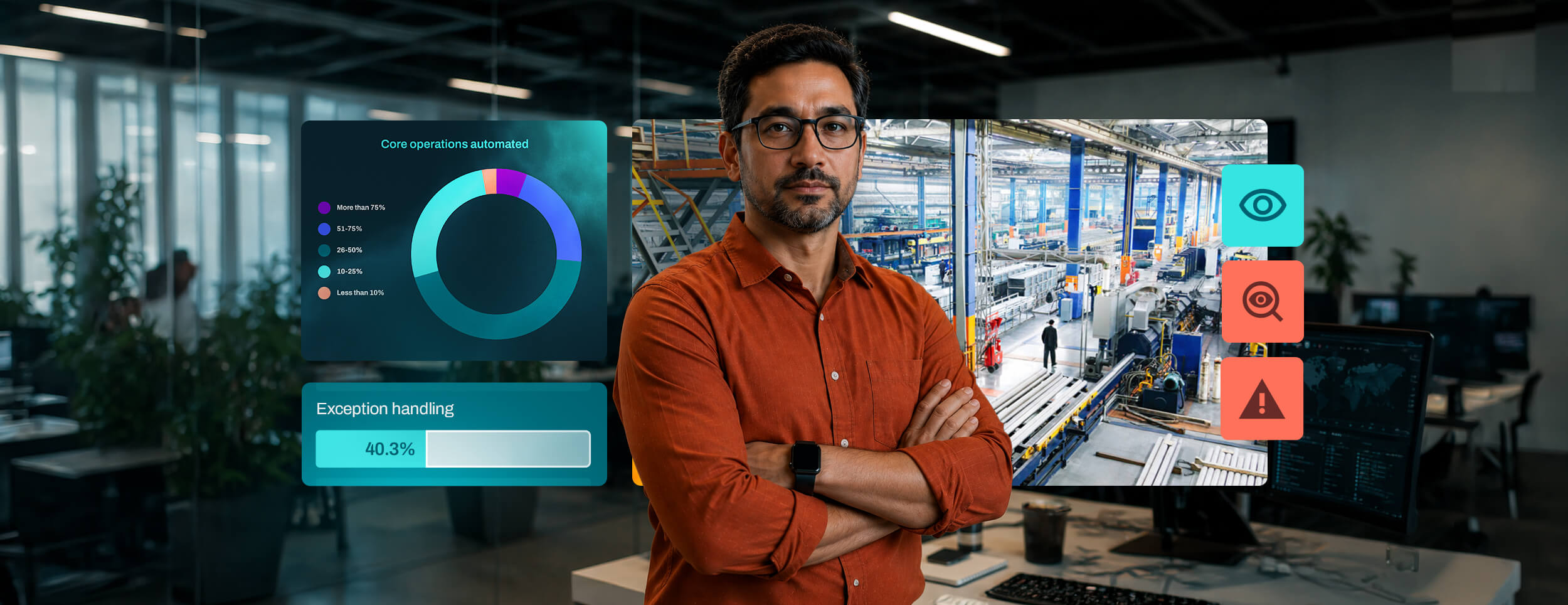
That pattern is exactly what Redwood Software’s “Manufacturing AI and automation outlook 2026” research confirms. Only about 40% of manufacturers have automated exception handling, yet 22% call it a top operational bottleneck. 

I find that gap genuinely striking. The workflows that carry the most risk, the ones where a slow response costs you, are the ones most likely to depend on a person in the right place at the right time.

Automation stops at the system boundary

Most automation tools are built for predictable conditions: known inputs, fixed sequences and logic that lives inside one application. That works fine when everything goes to plan, but exceptions are the opposite of that.

Take a supplier delay. It doesn’t sit in your supply chain platform. It touches your production schedule, inventory positions, customer commitments — almost immediately. A quality deviation detected in your MES needs to reach your ERP for financial impact, feed into compliance tracking and trigger replanning. None of that happens in one system.

This is where a lot of automation strategies fall apart. The tools you’ve deployed were designed for steady-state operations. When an exception hits a system boundary, the automated response stops and a person picks it up. The orchestration doesn’t extend across systems, so humans become the connective tissue.

Point automation solves for execution within a single system. But exception handling requires the ability to detect a state change in one place, evaluate what it means in context and trigger the right sequence of actions across multiple systems in the right order. That’s orchestration, and most manufacturers haven’t built that layer yet. Instead, they’ve built siloed automation inside individual systems and informal coordination between them.

Manual exception handling also limits where AI can go. AI-driven tools in manufacturing depend on consistent, event-driven data across systems. When exceptions break that flow, or when a quality deviation sits unresolved in one system while others operate on stale context, the operational foundation AI needs simply isn’t there. 

Manufacturers asking why their AI pilots aren’t scaling often find the answer in the gaps that manual exception handling creates. That connection between data flow maturity and AI readiness runs deeper than most automation roadmaps account for. 

Running on schedules while exceptions don’t wait

Another research finding that stuck with me: roughly 78% of manufacturers have automated less than half of their critical data transfers. That’s a lot of data still moving on schedules.

The problem with scheduled data movement is that exceptions surface late. If your systems are syncing every few hours, you’re working with a picture of what happened, not what’s happening. By the time the exception shows up in the right system, the downstream effects — inventory misalignment, planning data out of sync, decisions made on stale information — are already in motion.

Event-driven workflows change that. When the exception occurs, it propagates immediately. Paired with well-defined SLA rules, which surface delays before they compound, the response starts before the damage has time to spread. That’s an entirely different operating model, not just a faster version of the same one. 

Build your automation capabilities around orchestration rather than mere task execution, and you get end-to-end processes designed to handle conditional logic across systems rather than within them. It changes what your automation solutions can deliver.

Uptime is the easy metric. This is the hard one.

Here’s how I think about automation maturity: How much of your operation holds together when something goes wrong — without someone having to step in? 

Early-stage automation gets individual tasks off someone’s plate. Mid-stage gets processes partially connected. But exceptions still route to people, because the automation wasn’t built to handle variability across systems. High-maturity organizations have extended automation into that gap: detecting exceptions automatically, triggering coordinated responses across ERP, MES and supply chain systems, without waiting for a human to notice and act.

A manufacturer that hums along under normal conditions but loses hours to manual firefighting every time something deviates is operating at a lower maturity than its uptime numbers suggest. KPIs like inventory turns and data accuracy lagging behind operational uptime, which we saw consistently in the research, are often a symptom of this exact gap.

Think about what happens during manual firefighting. Someone:

  1. Identifies the exception
  2. Figures out which systems are affected
  3. Contacts the right people in each function
  4. Waits for responses 
  5. Manually updates records across platforms

The outcome depends heavily on who’s available and how well they know the cross-system dependencies. Two people handling the same exception type can produce meaningfully different results. That inconsistency doesn’t show up on an uptime dashboard. But it does show up in inventory accuracy, planning reliability and, eventually, customer commitments.

Don’t treat disruption as an edge case

Exception handling often gets treated as something you’ll address after the core processes are running smoothly. The next phase, the future state, the thing on the roadmap after the bigger wins.

That sequencing is backwards. Your most critical workflows are also the ones most likely to break down under real conditions. Automating the steady-state version of those workflows and leaving the exception paths manual means your automation coverage is highest exactly where the stakes are lowest.

Automation metrics tell you what you’ve built for, but how your team handles exceptions tells you how well it works. It’s key to automate disruption as well as execution.

The full “Manufacturing AI and automation outlook 2026” goes deeper on exception handling, with benchmarks on automation maturity and common challenges in the industry. Read the full report.